When Business Changes Faster Than Its Data
What continuous transformation demands of the modern data organisation.
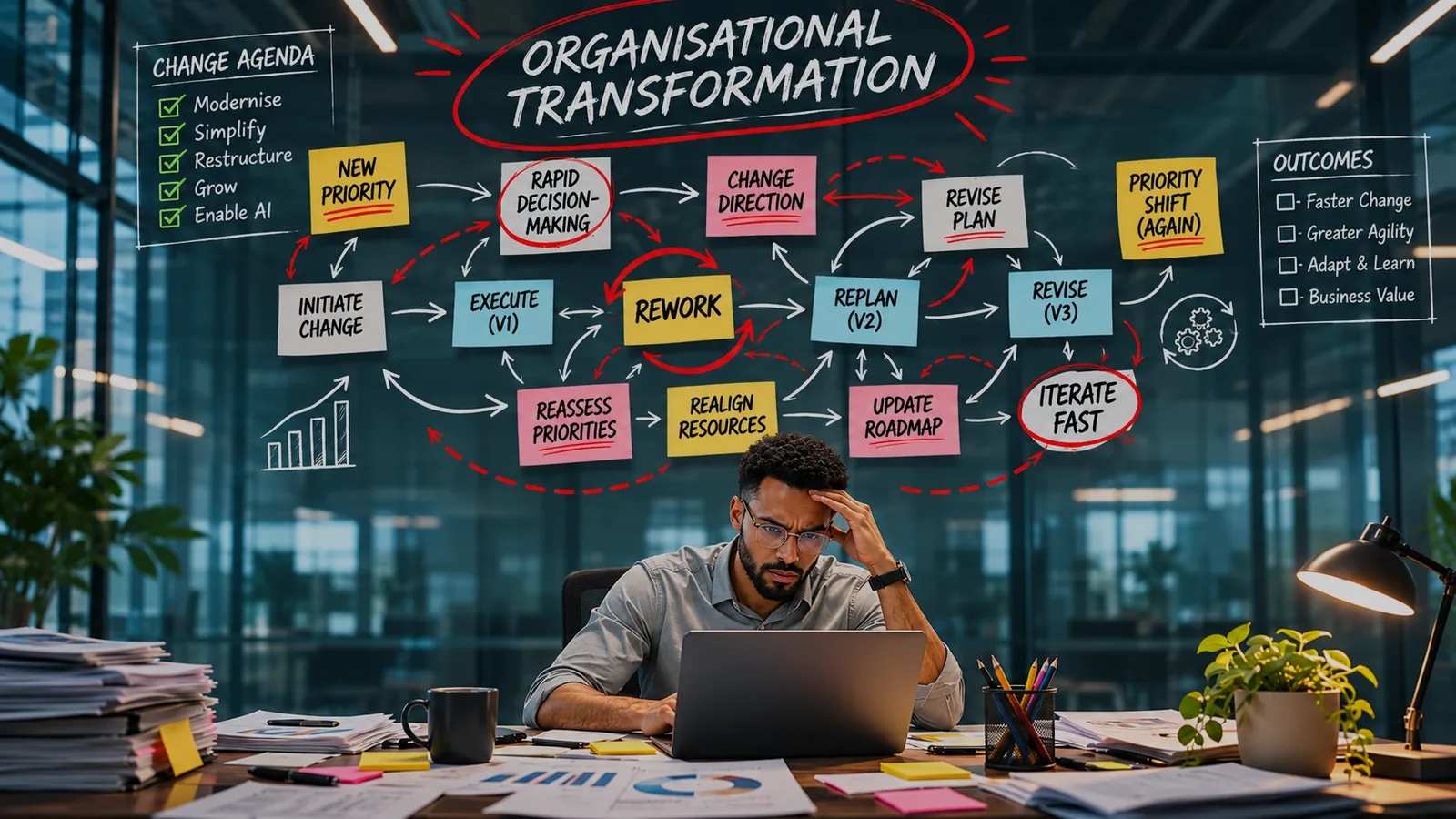
An ERP transformation is already underway. A newly acquired business needs to be integrated. Operating processes are being redesigned. Meanwhile, leadership wants AI to improve decisions and automate work across the organisation.
Each initiative has a business case, a sponsor and a delivery plan. Yet beneath them sits a difficult question: does the organisation still have a consistent understanding of its own data?
A customer may be represented differently across business units. An asset may carry different classifications in operational and financial systems. A performance measure may mean one thing to Finance and another to Operations.
These inconsistencies are not necessarily new. What has changed is the speed at which organisations encounter them.
Business change is accelerating. But the data foundations supporting that change often evolve much more slowly.
That gap is becoming one of the defining challenges for enterprise data management.
Change is no longer a programme. It is the operating environment.
Organisations have always changed. They have introduced new systems, reorganised divisions, acquired businesses and responded to new regulations.
What makes the current environment different is the combination of changes happening simultaneously.
Cloud modernisation may be running alongside ERP replacement. New applications are introduced before older systems are retired. Business units are adopting AI while enterprise architecture teams are still rationalising existing platforms. Changes to regulations, customer expectations and operating models introduce further requirements.
There is rarely a clean moment when one transformation finishes and the organisation becomes stable again.
This changes the role of data.
Traditionally, many organisations treated data management as something established within a major programme: define the data architecture, build integrations, migrate the records, implement reporting and transition into operations.
That approach can work for a defined project. It becomes less effective when the next transformation begins before the previous architecture has settled.
Data can no longer be designed only for the organisation as it exists today. It must accommodate how the organisation will continue to change.
The important distinction is between building a solution that survives its next go-live and establishing data capabilities that remain useful through multiple changes.
The real complexity sits between systems, processes and business meaning
Consider a relatively ordinary enterprise scenario.
A company replaces its financial system while retaining its existing asset management platform. Both systems represent suppliers, cost centres and organisational structures differently. During implementation, teams develop mappings and reconciliation rules to connect them.
The new financial system goes live successfully.
Six months later, the organisation restructures its divisions. Ownership changes, reporting hierarchies are revised and a new business is integrated.
The technology may still work perfectly. But the assumptions embedded in data mappings, integration rules, ownership models and reporting structures may no longer reflect the business.
This is where technical modernisation and enterprise data architecture diverge.
Moving data between platforms is not the same as maintaining a consistent understanding of that data across the enterprise.
A modern cloud platform can process information faster. It cannot, by itself, resolve conflicting business definitions, unclear accountability or incompatible operating practices.
Likewise, integrating systems does not automatically establish shared meaning.
The challenge is not simply to connect data. It is to preserve its meaning, integrity and accountability as the business changes around it.
This requires architectural decisions about business concepts, information boundaries, relationships, ownership and dependencies — not just technology selection.
AI is making the consequences more immediate
AI adds another dimension to the challenge.
When analytics produces an incorrect or incomplete report, someone may identify the problem during interpretation or review.
When an AI-enabled workflow uses incomplete, outdated or misunderstood data to recommend or initiate an action, that weakness can influence operations more directly.
The risks depend on the use case and the controls in place, but the underlying lesson is important: more capable automation increases the need for dependable information and appropriate governance.
The industry's research increasingly reflects this pressure.
The EDM Association's 2026 Global Data Management Benchmark, drawing on more than 435 organisations across over 50 countries, highlights a persistent gap between AI investment and enterprise data-management readiness.
The challenge is not necessarily a lack of technology. It is that the information, business context, accountability and operational controls required to use that technology effectively are often less mature.
For organisations moving towards AI-assisted and agentic workflows, the question becomes more demanding.
Can systems establish which information is authoritative? Can they understand relevant business context? Are data quality concerns visible? Who is authorised to approve decisions? Can actions be traced and reviewed?
These are enterprise data-management questions as much as they are AI questions.
The more intelligently organisations want their systems to operate, the more deliberately they need to manage the information those systems depend upon.
Data governance must move closer to where change happens
Many governance initiatives begin by establishing committees, policies, standards and responsibilities.
These foundations matter. But governance becomes valuable only when it influences how information is created, changed, shared and used.
A policy alone will not prevent a transformation team from introducing a conflicting customer definition. A data catalogue alone will not resolve ownership disagreements. A quality dashboard alone will not ensure that someone acts on a critical issue.
In a continuously changing organisation, governance needs to be connected to delivery.
When a new application is introduced, teams should understand its relationship to existing business information. When a data structure changes, downstream impacts should be visible. When ownership moves, accountability needs to move with it.
The objective should not be to introduce additional approval layers for every change.
It should be to establish practical governance that makes responsible decisions easier and important risks visible earlier.
This requires clarity about which decisions need formal oversight and which can be managed through well-defined standards, accountability and automated controls.
Governance should help an organisation move confidently — not merely ask it to slow down.
Migration is becoming a recurring enterprise capability
One of the clearest consequences of continuous transformation is that data migration is no longer an occasional technical exercise.
Organisations migrate data when they replace applications, consolidate platforms, restructure operations, integrate acquisitions or introduce new enterprise capabilities.
Yet each migration often begins with familiar activities.
Teams identify source systems, establish target structures, document mappings, assess quality, resolve dependencies and coordinate decisions across multiple stakeholders.
Too often, the knowledge developed during one initiative remains scattered across documents, spreadsheets, individual teams and project repositories.
When the next migration begins, considerable effort is spent rediscovering information the organisation has already worked to understand.
This suggests a different approach.
Migration knowledge should become reusable organisational knowledge, rather than something assembled and abandoned within individual projects.
That does not require every migration to follow an identical method. Different systems, business requirements and risks will always demand different techniques.
It does require a more consistent approach to maintaining scope, ownership, mapping decisions, quality considerations, dependencies and governance evidence.
The opportunity is to make each transformation better informed by the work that came before it.
Designing a data organisation that can absorb change
So what should enterprise leaders do differently?
Start by recognising that data architecture and management are not simply supporting activities within technology programmes. They are capabilities that help the organisation adapt.
An enterprise should be able to understand its important information assets, their business meaning, the systems that manage them and the consequences of changing them.
Ownership should extend beyond individual projects. Metadata, quality expectations and dependencies should remain useful after a project team disbands.
Data engineering should provide the flexibility to connect and evolve platforms without repeatedly rebuilding fundamental business understanding.
And governance should be practical enough to operate within day-to-day decisions.
None of this demands a single enterprise-wide technology platform or a large centralised data team. A well-designed federated model may be more appropriate, provided responsibilities, standards and shared information are sufficiently clear.
The real test is not whether an organisation has implemented every data-management capability.
It is whether those capabilities help it respond more effectively when something important changes.
A useful question for executives is:
If our business changed significantly tomorrow, how quickly could we understand what that means for our data?
Could we identify affected systems and information? Understand the implications for reporting and operations? Find accountable owners? Assess migration and quality risks? Make decisions using dependable evidence?
The answers reveal far more about enterprise data readiness than the number of platforms, policies or dashboards an organisation has implemented.
The next transformation should not mean starting again
Organisational change will continue. Technologies will evolve, operating models will shift and expectations of data will increase.
Trying to anticipate every future requirement is unrealistic.
But designing enterprise data capabilities that can accommodate change is entirely achievable.
The organisations best positioned for what comes next will not necessarily be those with the largest technology investments. They will be those that can maintain a clear understanding of their information, adapt their architecture, preserve accountability and apply what they have already learned.
The goal is not to eliminate complexity. It is to stop rediscovering and rebuilding the same foundations every time the business changes.
Where DataVirtue can help
At DataVirtue, we believe enterprise data capabilities should evolve with the organisation — not become another constraint on change.
Our consulting expertise brings together enterprise data strategy, architecture, engineering and governance to help organisations understand their existing information environments, make informed decisions and establish practical foundations for future transformation.
We are also extending that experience into purpose-built technology. DataVirtue Data Migration Governance is designed to help organisations establish greater structure, visibility and accountability around the migration information and decisions that transformation programmes depend on.
By combining practical enterprise experience with reusable technology, our aim is to help organisations approach change with greater clarity, consistency and confidence.
Because the next transformation should build on what an organisation already knows — not force it to begin again.
Sources
- EDM Association, 2026 Global Data Management Benchmark — https://edmcouncil.org/announcement/edm-association-benchmark-reveals-growing-gap-between-data-management-capability-and-ai-implementation/
- Enterprise Data Strategy
- Data Architecture
- Data Governance
- Data Migration
- AI
- Transformation